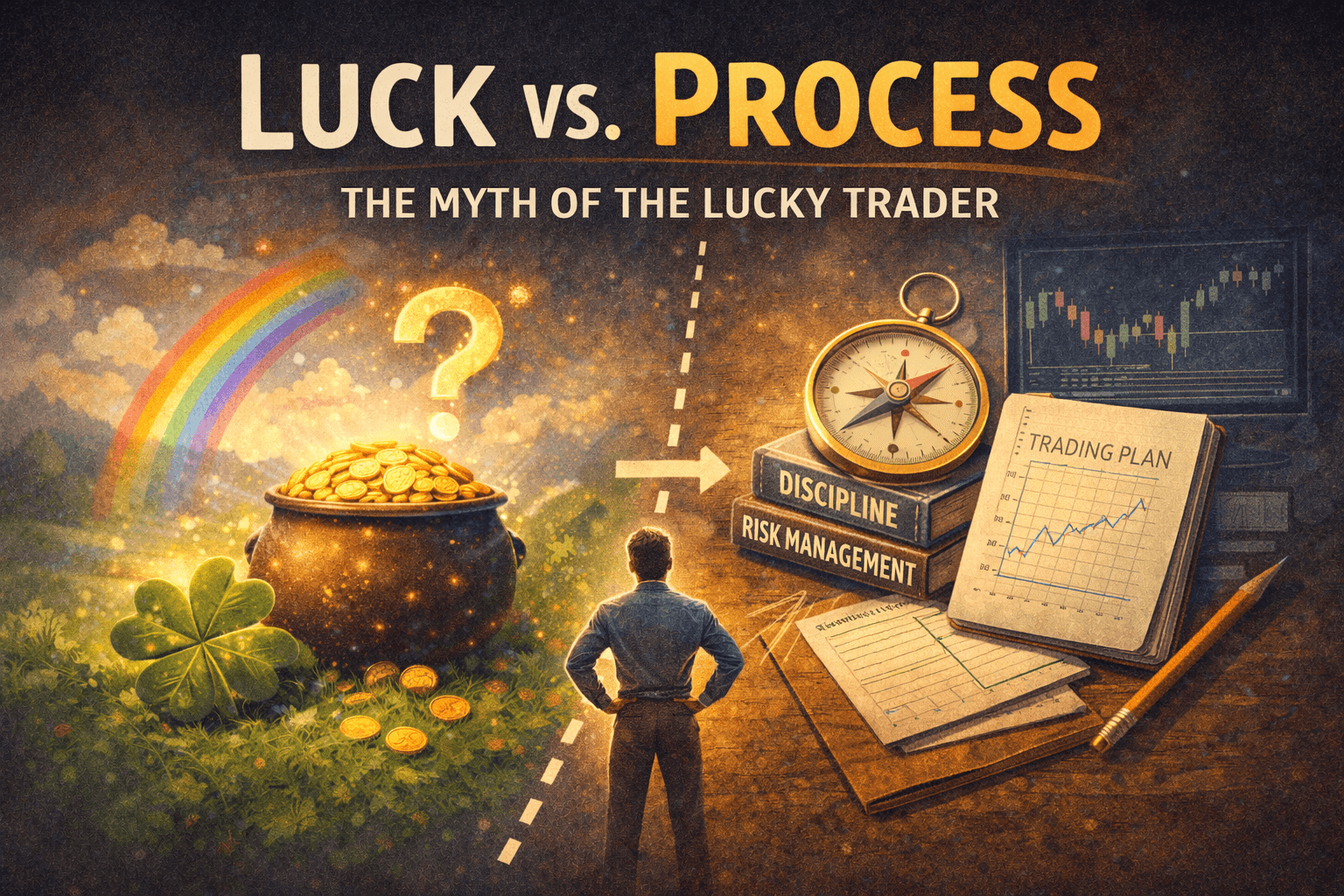
Every March, we celebrate luck.
Four-leaf clovers. Pots of gold. Fortunes discovered at the end of rainbows.
St. Patrick's Day is built around the idea that success is something stumbled upon — something found unexpectedly, as if wealth and good fortune are simply waiting to be uncovered by the right person at the right moment.
Markets are often viewed the same way.
The Illusion of the Lucky Trade
When someone catches a big move — a breakout stock, a perfectly timed option, a surge in a trending theme — observers rarely ask about the process behind it. They assume the trader saw something special. Or worse, they assume the trader got lucky.
In the short term, it can be hard to tell the difference.
Markets are probabilistic. A reckless trade can win. A disciplined trade can lose. Outcomes and skill are not perfectly aligned over small samples. That ambiguity creates room for the myth of luck to thrive.
But over time, luck does not compound.
Process does.
Why Luck Is So Attractive
Luck is emotionally appealing because it requires no structure. It allows us to believe that a single bold decision can dramatically change our financial future. It suggests that somewhere out there is a "pot of gold" trade — the one that will make up for all prior mistakes.
That narrative is powerful. It is also dangerous.
Chasing luck encourages oversized risk. It encourages reacting to headlines. It encourages abandoning discipline when a tempting opportunity appears. The focus shifts from building a repeatable edge to chasing isolated wins.
The irony is that even when luck delivers a short-term gain, it often reinforces the wrong behavior.
Process Is Quiet
A systematic trading approach rarely looks dramatic. There are no heroic predictions. There are no sudden declarations that "this is the big one." Instead, there is structure.
Rules are defined in advance. Risk is sized deliberately. Exposure shifts only when broader conditions change.
This kind of framework can feel underwhelming in the moment. It does not promise immediate transformation. It does not rely on perfect foresight.
What it does provide is consistency.
And consistency is what allows compounding to work.
The Difference Over Time
In a single week, luck and process can look identical.
In a single month, they may still look similar.
Over years, they diverge completely.
Luck produces erratic equity curves — bursts of growth followed by sharp reversals. Process produces something steadier. Not smooth, not perfect, but governed by rules rather than impulse.
A structured regime approach, for example, does not attempt to predict every twist in the market. It identifies broader environments — when risk is being rewarded and when it is being punished — and allocates accordingly. It accepts that not every move will be captured and that some drawdowns are inevitable.
That humility is intentional.
It replaces the search for lucky timing with a repeatable framework.
Skill Isn't Obvious at First
One of the hardest parts of trading is accepting that good decisions do not always lead to immediate rewards. A disciplined trade can lose money. A reckless one can make it.
In those moments, luck appears superior.
But skill reveals itself in durability. It shows up in survival during difficult regimes. It shows up in the ability to follow the same process when recent results are disappointing. It shows up in the absence of catastrophic mistakes.
Luck may create stories. Process builds track records.
The Real "Pot of Gold"
St. Patrick's Day imagery suggests that wealth is discovered at the end of a journey — that if you chase the rainbow long enough, something extraordinary will be waiting.
Markets rarely work that way.
There is no single trade that solves everything. There is no hidden shortcut that eliminates risk. The "pot of gold" in trading is not a windfall. It is the accumulated result of disciplined behavior repeated hundreds of times.
It is risk managed carefully. It is capital preserved during adverse conditions. It is patience exercised when excitement is tempting.
Over time, those behaviors compound into something that may look like luck from the outside.
From the inside, it is simply process.
Choosing Process Over Luck
As information accelerates and commentary grows louder, the temptation to chase "the big one" will only increase. There will always be another headline, another prediction, another opportunity framed as rare and urgent.
Choosing a systematic approach is a decision to step out of that cycle.
It is an acknowledgment that long-term success is less about finding fortune and more about following structure. It is a commitment to discipline over drama.
Luck makes for a good holiday theme.
In markets, process is what endures.