
History of the Market Regime Model - Part 3 (2015-2018)
2015-2018: Crash, Reflation, Melt-Up, and Volpocalypse
This article is part of a multi-part series where I walk through how the Market Regime model would have navigated different historical market environments. To keep things simple and transparent, I’m using TQQQ during Bullish regimes and GLD during Bearish regimes as proxies for how the system behaved in real time. Of course, past performance never guarantees future results—but understanding how a model responds across different conditions is exactly why I trade it live today. Seeing how it handled both calm and chaotic markets helps illustrate the consistency and robustness that make this approach so powerful.
In case you missed it, here’s links to the entire series:
Part 3
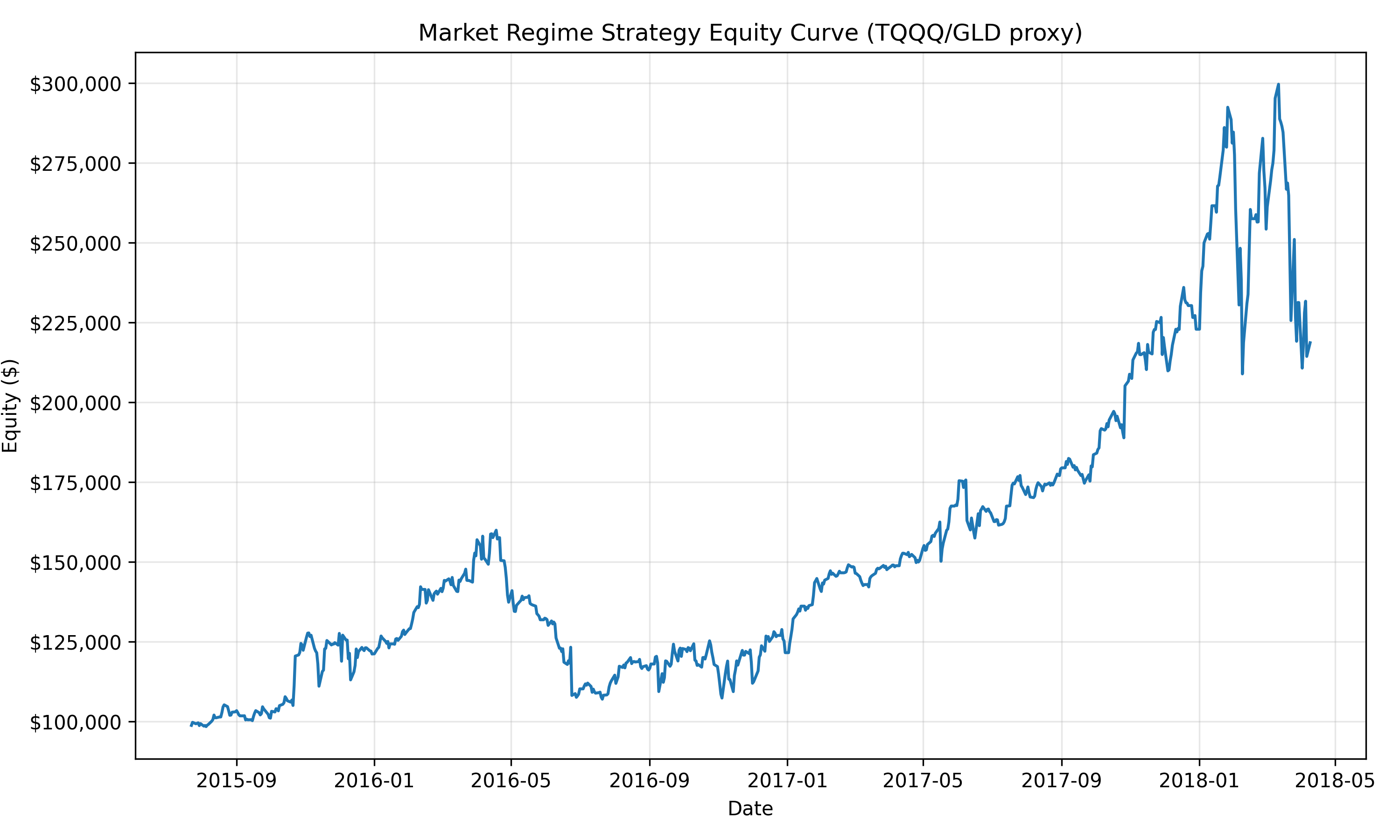
Part 3 begins at one of the most pivotal moments of the decade: July 23, 2015, the day the model flipped Bearish—just weeks before China’s surprise yuan devaluation triggered a violent global selloff. What followed was a period defined by rapid shifts in sentiment, policy pivots, geopolitical shocks, and one of the strongest bull markets ever recorded.
The Market Regime model navigated all of it with quiet consistency. Over this 2.7-year window, the strategy turned $100,000 into $221,332, producing a +121.33% total return, a 34.02% CAGR, and a 56.25% win rate across 16 trades. It sidestepped the worst of the 2015–2016 volatility, participated aggressively during the 2016–2017 reflation trade, and rode the powerful 2017 melt-up while avoiding catastrophic risk during the 2018 Volmageddon shock.
This was a period where many discretionary traders were repeatedly wrong-footed. The Market Regime model simply followed leadership.
PHASE 1 — 2015–2016: China Crash, Panic, and the Global Reflation Turn
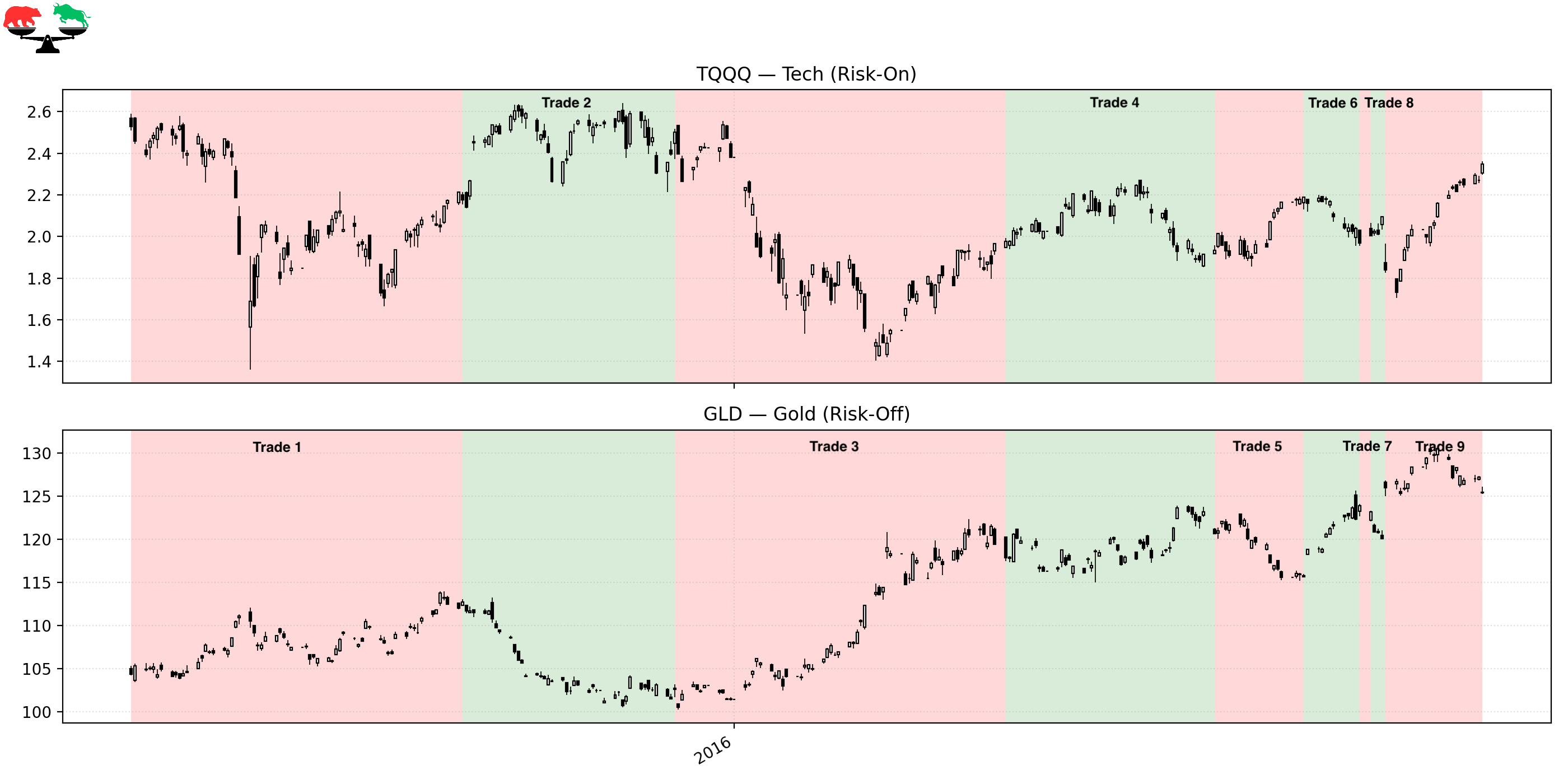
Trade 1 – Defensive Positioning Before the China Devaluation Crash
Instrument: GLD
Start: 2015-07-23
End: 2015-10-20
Length: 89 days
Return: +8.05%
This Bearish regime began at a remarkably well-timed moment. Just weeks later, China unexpectedly devalued the yuan, triggering a sharp global selloff and multiple 1,000-point Dow futures limit-down sessions. While equities dropped violently, GLD provided stability and positive return. This is one of the clearest demonstrations of the model stepping aside during genuine risk-off chaos.
Trade 2 – Rebound Participation After the Crash
Instrument: TQQQ
Start: 2015-10-20
End: 2015-12-16
Length: 58 days
Return: +14.98%
Markets rebounded sharply as panic selling exhausted itself. Growth stocks and tech regained leadership, and volatility normalized. The model re-entered TQQQ early in the recovery, capturing the majority of this snapback rally. This trade shows how quickly systematic approaches can re-engage after turbulence.
Trade 3 – Defensive Through the January–February 2016 Panic
Instrument: GLD
Start: 2015-12-16
End: 2016-03-14
Length: 89 days
Return: +14.72%
As the Federal Reserve began its first rate-hike cycle in years, markets cracked again. January 2016 remains one of the worst opening months in market history, with credit stress, energy defaults, and recession fears dominating sentiment. GLD surged during this environment, delivering one of the strongest defensive trades in the entire dataset. The model stayed completely out of the 2016 equity washout.
Trade 4 – A False Start Before the Real Recovery
Instrument: TQQQ
Start: 2016-03-14
End: 2016-05-09
Length: 56 days
Return: –2.26%
This Bullish flip marked the first attempt at recovery after the February 2016 bottom. However, the early rebound was uneven, with credit spreads tightening only gradually and leadership still unstable. The trade produced a small loss, reflecting the fragility of the period. Still, this flip placed the model in position for the powerful move that came next.
Trade 5 – Defensive Before the Breakout
Instrument: GLD
Start: 2016-05-09
End: 2016-06-02
Length: 24 days
Return: –4.13%
The regime briefly turned Bearish as markets consolidated. Gold declined mildly, but the important dynamic was the model avoiding premature bullish exposure before true leadership emerged. This was a choppy, low-signal period where defensive positioning reduced volatility.
Trade 6 – Bullish Attempt Interrupted by Brexit Fears
Instrument: TQQQ
Start: 2016-06-02
End: 2016-06-17
Length: 16 days
Return: –10.11%
Markets briefly strengthened in early June, but uncertainty rose rapidly as the Brexit referendum approached. Risk assets faded, and volatility spiked into the vote. The model entered TQQQ in improving conditions but was quickly whipsawed as fear overtook price action.
Trade 7 – A Short, Protective Turn
Instrument: GLD
Start: 2016-06-17
End: 2016-06-20
Length: 3 days
Return: –0.60%
This short Bearish rotation reflected rising anxiety heading into the Brexit vote. Gold did not surge yet, but the model’s defensive stance was directionally aligned with market stress. These micro-trades are part of navigating highly binary macro moments.
Trade 8 – Bullish Misfire Into a Global Shock
Instrument: TQQQ
Start: 2016-06-20
End: 2016-06-24
Length: 5 days
Return: –8.23%
Markets initially priced in a “Remain” outcome, strengthening risk-on conditions. The regime flipped Bullish—but only days later, the UK shocked the world by voting to leave the EU. Equity markets plunged, volatility exploded, and TQQQ suffered. The model quickly corrected course on the next flip.
Trade 9 – The Brexit Buffer Trade
Instrument: GLD
Start: 2016-06-24
End: 2016-07-20
Length: 27 days
Return: –0.49%
Immediately following Brexit, the model rotated back into GLD, avoiding the worst of the panic. Gold initially spiked, then consolidated, producing a flat net return. But the real value came from avoiding leveraged equity exposure during a period of elevated uncertainty. With risk assets stabilizing afterward, the next major opportunity emerged.
PHASE 2 — 2016–2018: Global Reflation and the Melt-Up
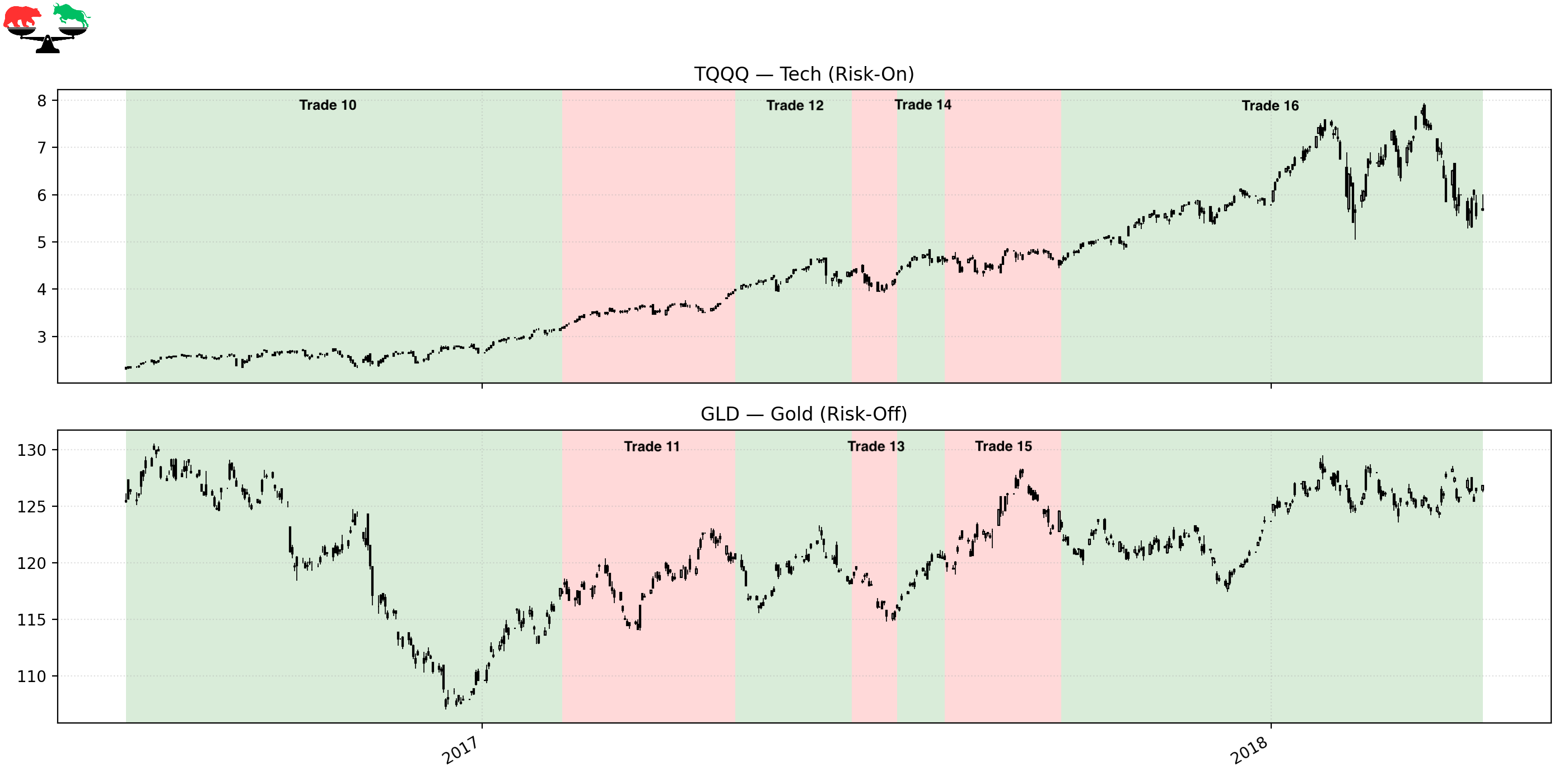
Trade 10 – The Monster Reflation Trade
Instrument: TQQQ
Start: 2016-07-20
End: 2017-02-07
Length: 203 days
Return: +35.92%
This is the defining trade of the period. Following Brexit, global central banks eased aggressively, credit spreads tightened, commodities stabilized, and growth expectations improved. The market entered a powerful, broad-based reflation rally that lasted through early 2017. The regime model stayed Bullish the entire time, capturing nearly a +36% leveraged trend.
Trade 11 – A Defensive Pause During Political Volatility
Instrument: GLD
Start: 2017-02-07
End: 2017-04-28
Length: 80 days
Return: +2.82%
As volatility returned around political events, global trade negotiations, and shifting fiscal expectations, risk-on leadership softened. The model stepped aside into GLD, which offered moderate gains. This trade reflects the “breathing room” phase between major upside legs.
Trade 12 – Early Participation in the 2017 Melt-Up
Instrument: TQQQ
Start: 2017-04-28
End: 2017-06-21
Length: 54 days
Return: +10.37%
This trade captured the early phase of one of the strongest, most persistent market advances in modern history. Growth, momentum, and large-cap tech surged with almost no pullback. The model correctly re-entered TQQQ and participated in another clean upside run.
Trade 13 – A Minor Defensive Detour
Instrument: GLD
Start: 2017-06-21
End: 2017-07-12
Length: 22 days
Return: –2.10%
A brief period of volatility and leadership rotation caused a temporary Bearish flip. Gold softened modestly, but the trade was short-lived. This small setback is typical of regime systems operating in low-volatility bull markets.
Trade 14 – Riding the Melt-Up Resumption
Instrument: TQQQ
Start: 2017-07-12
End: 2017-08-03
Length: 23 days
Return: +5.61%
The melt-up resumed almost immediately, driven by synchronized global growth and exceptionally low volatility. Tech leadership strengthened again, and the model captured another leg of the advance. This was a textbook short-duration trend trade.
Trade 15 – Defensive Shift Ahead of a Volatile Fall
Instrument: GLD
Start: 2017-08-03
End: 2017-09-26
Length: 55 days
Return: +2.11%
Sentiment wavered moving into late 2017, with geopolitical tensions and yield-curve concerns rising. Gold provided modest upside while equities chopped sideways. The model reduced exposure at a time when risk appeared less directional.
Trade 16 – The Final Bullish Trade Before Volmageddon
Instrument: TQQQ
Start: 2017-09-26
End: 2018-04-09
Length: 196 days
Return: +24.73%
This trade captured the heart of the 2017 melt-up—one of the strongest, smoothest advances in history—as well as the post-correction recovery after the infamous February 2018 volatility explosion. TQQQ surged during the melt-up and held firm even after the volatility shock reset markets. The trade ended on April 9, 2018, the day the regime flipped Bearish, marking a natural and dramatic end to this chapter.
FINAL THOUGHTS
Here’s a recap of the trades taken during this period:
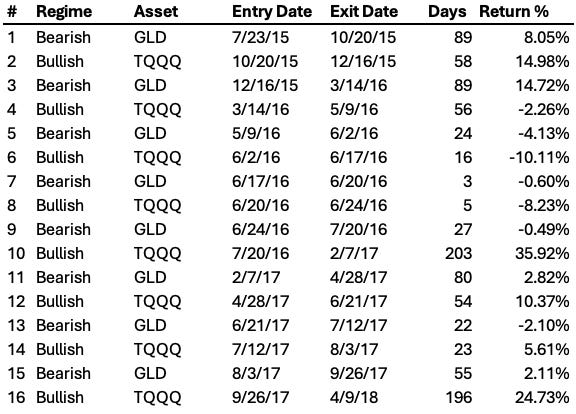
The 2015–2018 period was a masterclass in how chaotic markets can still produce exceptional long-term results if approached systematically. The model endured whipsaws during the China crash, Brexit volatility, and the early 2016 bottoming process, yet it stayed patient and captured some of the most explosive upside moves of the decade. With +121.33% total return, and a 34.02% CAGR, the system showed remarkable resilience and adaptability through wildly different environments—crashes, recoveries, melt-ups, and volatility supernovas. Many discretionary traders were repeatedly shaken out during this era. The Market Regime model simply followed the data.
Coming Next: 2018-2020 — Crash, Recovery, and the Most Violent Event of All
Part 4 begins with the aftermath of Volmageddon and dives into:
The Q4 2018 waterfall decline
The powerful 2019 recovery
And ultimately, the 2020 pandemic crash, one of the fastest collapses in modern history
This next chapter is the most extreme yet—and it puts the discipline of the Market Regime model on full display.
These historical reports show how the model handled the past.
Paid subscribers get to see how it handles the present.
If you want the same clarity in your trading today that this model brought to 2012–2015, join the paid community and follow along in real time.