
Why People Quit During Drawdowns (And How to Avoid It)
The problem isn't the drawdown. It's what your brain does during one.

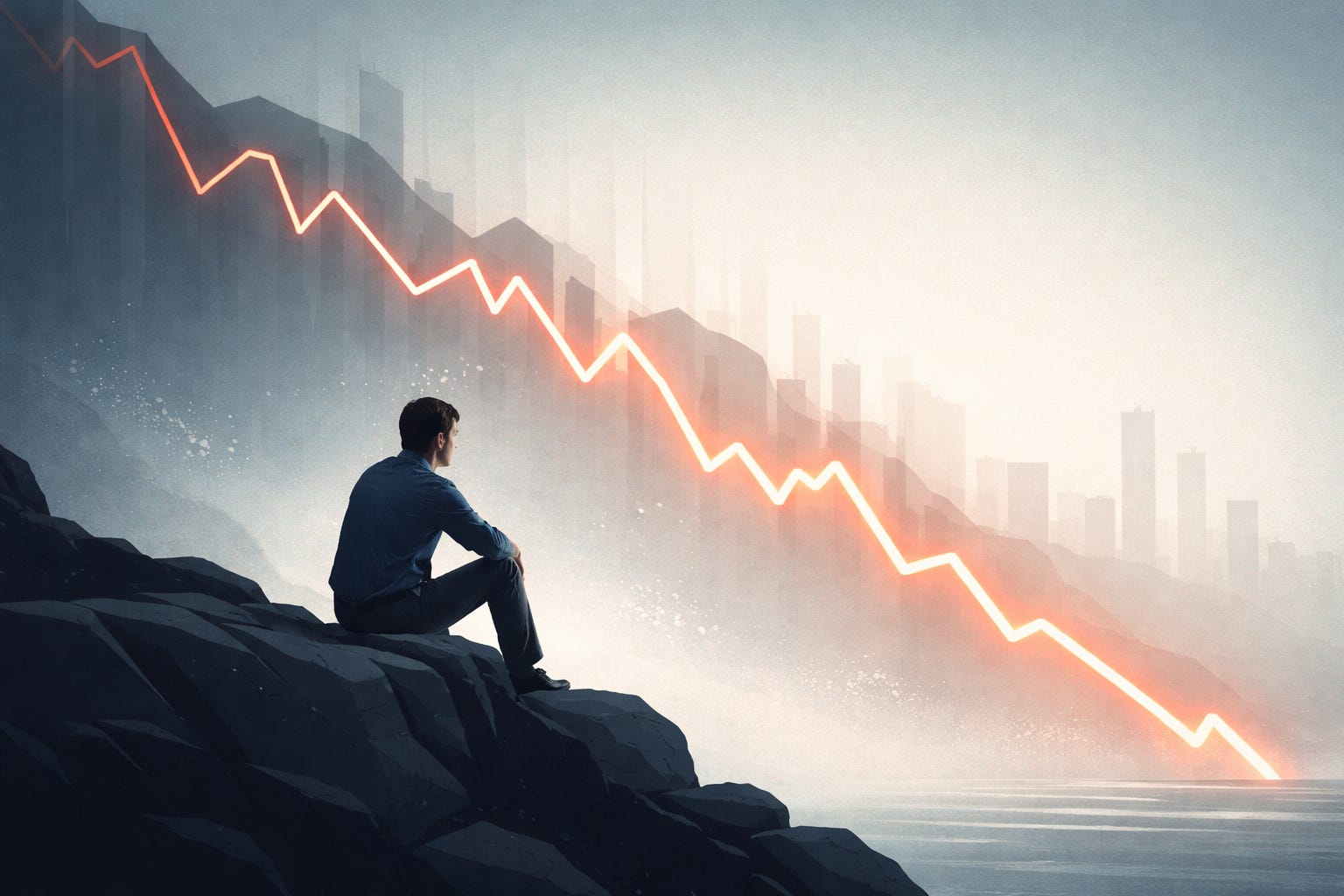
Every trading strategy that genuinely works eventually goes through a period where it feels broken. Not in an obvious, catastrophic way, but in a slow and grinding one. Returns stall, confidence erodes, and the strategy underperforms long enough that doubt begins to creep in.
This is the point where most traders give up. Not because the strategy failed, but because the psychological weight of the drawdown became intolerable.
Understanding why this happens is essential if you plan to follow a systematic strategy long enough for compounding to matter.
Drawdowns are psychologically harder than they look on paper
On paper, drawdowns are expected. They’re modeled, backtested, and discussed openly in almost every serious trading framework. Yet when a drawdown actually arrives, it rarely feels “expected.”
That disconnect exists because humans are loss-averse. Losses are felt roughly two to two-and-a-half times more intensely than equivalent gains, which means that a drawdown doesn’t register as normal variance in real time. It registers as something that needs to be fixed.
The brain’s first instinct isn’t to evaluate long-term expectancy. It’s to stop the discomfort. Quitting, reducing exposure, or abandoning the system altogether provides immediate relief — even if it causes long-term damage.
This response is not a lack of discipline. It’s a deeply ingrained survival mechanism that evolved to keep us alive, not to help us sit patiently through statistical noise.
Recency bias makes short-term pain feel permanent
During drawdowns, recent performance takes on outsized importance. Even traders who intellectually understand the long-term edge of their strategy find themselves heavily influenced by the most recent outcomes.
A strategy can have a decade or more of positive results, and yet a few months of underperformance are enough to create the feeling that “something has changed.” The present moment starts to feel like a permanent state rather than a temporary phase.
This is why so many strategies are abandoned near their worst point. The drawdown itself isn’t new, but the trader’s perception of it is.
Randomness starts to feel like incompetence
Trading forces us to make decisions under uncertainty, and uncertainty makes humans deeply uncomfortable. We prefer clear cause-and-effect relationships, even when they don’t exist.
As a result, during drawdowns, normal randomness often gets reinterpreted as failure. Losing trades are seen as evidence that the edge is gone rather than as expected outcomes within a probabilistic system. Variance begins to feel like a flaw in the strategy rather than the price paid for long-term returns.
This confusion between outcome quality and decision quality is one of the most common reasons traders abandon otherwise sound systems.
Drawdowns threaten identity, not just capital
The most overlooked aspect of drawdowns is that they don’t just affect a trading account. They affect how traders see themselves.
A prolonged period of underperformance raises uncomfortable questions. Was the past success real? Was it skill or luck? Is this strategy actually robust, or was it just well-timed?
Quitting often serves as a way to resolve this internal conflict. It allows the trader to externalize the failure — to say that the strategy stopped working — rather than confronting the discomfort of sticking with a plan through uncertainty.
Systematic strategies remove the illusion of control
Ironically, systematic strategies amplify these psychological pressures. By design, they remove discretion, excitement, and the feeling of control. There is nothing to tweak, override, or optimize in real time.
During drawdowns, that lack of action can feel like helplessness. The absence of decision-making creates space for doubt to grow, and the temptation to intervene becomes strongest at exactly the wrong moment.

How to avoid abandoning a strategy during drawdowns
Avoiding this trap isn’t about suppressing emotion or becoming unusually disciplined. It’s about structuring the system — and your behavior — so that normal human responses don’t derail long-term results.
Pre-commit to what “normal” looks like
Before trading a strategy with real capital, it’s essential to define what normal pain looks like. That includes expected drawdown depth, expected duration, and the worst historical experiences the system has endured.
When these boundaries are written down in advance, a drawdown becomes something to evaluate rather than something to react to. Instead of asking whether the strategy is broken, the question becomes whether the current experience fits within previously observed behavior.
Size positions to protect decision-making, not just capital
Position sizing is as much a psychological tool as it is a financial one. If a drawdown affects sleep, mood, or behavior, the size is too large — regardless of what the math says.
The goal is not to eliminate discomfort entirely, but to keep it from overwhelming judgment. A strategy that is theoretically sound but emotionally untradeable will not survive long enough to deliver its edge.
Measure process when outcomes are noisy
During drawdowns, returns are a poor diagnostic tool. Instead, attention should shift to execution quality and adherence to rules.
Was the strategy followed? Were signals taken consistently? Were there deviations from the plan?
Being able to answer these questions provides stability when P&L does not.
Separate research from execution
Most strategies are not abandoned because they are fundamentally flawed. They are abandoned because they are constantly adjusted in response to short-term noise.
Establishing clear boundaries between research periods and execution periods prevents emotional decision-making during stressful moments. Changes should be made deliberately, not reactively.
Anchor decisions to logic, not results
For regime-based systems in particular, underperformance during certain environments is not only expected — it’s often the correct outcome.
Evaluating whether the market environment aligns with the system’s thesis is far more informative than evaluating recent returns. When logic and environment align, patience becomes easier to maintain.
The real advantage most traders underestimate
Every durable edge requires periods of discomfort. If it didn’t, it would be easy to follow and quickly arbitraged away.
The ability to endure drawdowns is not a character flaw to overcome. It is a structural advantage — one that compounds quietly over time.
Final thought
Rather than asking how to avoid drawdowns, a better question is how to build a system and a life that can withstand them without forcing abandonment.
That is the difference between strategies that look good on paper and strategies that survive long enough to matter.
I really like your very reflected way of naming patterns we observe in the market. Sticking to a strategy and paying less attention to the noise in the market is an excellent and yet demanding strategy. But if we manage to anchor our investment decision in solid and coherent analysis we're ahead of most market participants.